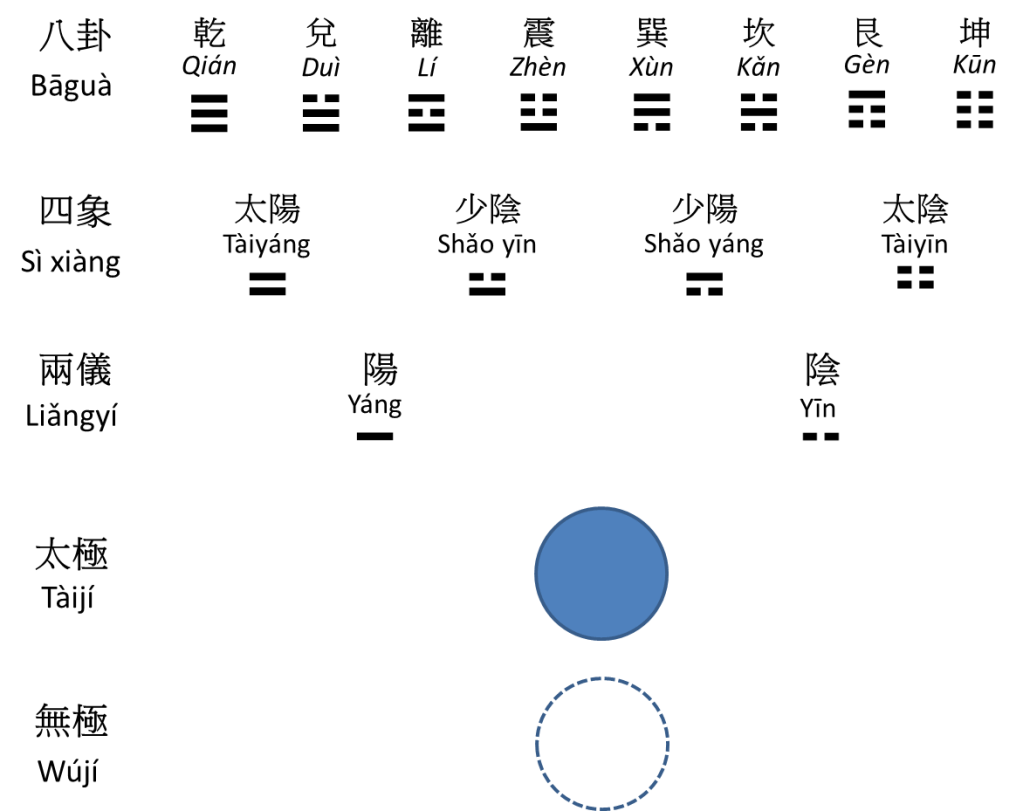
L’Illimitato (無極; wuji) produce il delimitato (有極; youji), e questa demarcazione è equivalente all’Assoluto (太極; taiji). Il Taiji (le due forze opposte in forma embrionale) produce due forme, denominate yin-yang (陰陽) che sono chiamate Liangyi (le forze opposte manifestate). Queste due forme producono quattro fenomeni chiamati: yin minore (少陰, shaoyin), yin maggiore (太陰; taiyin, che si riferisce anche alla Luna), yang minore (少陽, shaoyang) e yang maggiore (太陽; taiyang, che si riferisce anche al Sole). I quattro fenomeni (四象; Sìxiàng) agiscono sugli otto trigrammi (八卦; Bagua). Otto “otto” risultano in sessantaquattro esagrammi.
The Limitless (無極; wuji) produces the delimited (有極; youji), and this demarcation is equivalent to the Absolute (太極; taiji). The Taiji (the two opposing forces in embryonic form) produces two forms, named yin-yang (陰陽) which are called Liangyi (the manifested opposing forces). These two forms produce four phenomena: named lesser yin (少 陰, shaoyin), greater yin (太陰; taiyin, which also refers to the Moon), lesser yang (少陽, shaoyang), and greater yang (太陽; taiyang, which also refers to the Sun). The four phenomena (四象; Sìxiàng) act on the eight trigrams (八 卦; Bagua). Eight ‘eights’ results in sixty-four hexagrams.

 KF-OB
KF-OB 